For years, the Premier League was untouchable — a whirlwind of pace, power, drama, and unpredictability driven by billion pound broadcast deals.
It was football’s gold standard: the envy of the world, the most watched, most talked about, most thrilling domestic competition on Earth. But something’s changed. And if you’ve felt underwhelmed this season, you’re not alone.
This campaign — billed as one of the most open in years — has felt like the least compelling in memory. The title race was a two-horse procession that petered out early.
The relegation battle fizzled out weeks ago with all 3 promoted clubs unable to compete for a second successive season.
For a league sold on chaos and last-day drama, it’s all gone eerily quiet.
Is this just a one-off? Or could be the start of a shift? One that could have major consequences for the future of English football.
A League That’s Losing Its Meaning
When Manchester United and Spurs both field weakened sides in the Premier League to prioritise the Europa League, something’s off.
The idea that domestic fixtures — once the heartbeat of a club’s season — are now mere stepping stones to bigger continental stages and Champions League riches is worrying.
And next season, with 6 (Six) English teams qualifying for the Champions League, that competitive edge may dull even further. Mid-week European games will increasingly be the focus.
What used to be an elite reward is now within reach of half the “big” clubs. Where’s the drama in that?
More worryingly, it invites complacency. Once a club is nestled into 4th or 5th place what’s left to fight for? Mid-table clashes in April feel increasingly like pre-season friendlies in intensity. The Europa League once looked down upon is now more important than the bread and butter of Premier League fixtures.
The Rise of Competing Priorities
Looming over all of this is the expanded Club World Cup. A new global cash cow. And for top teams, a massive payday. In 2025, Chelsea and Man City will represent the Premier League in the revamped competition — potentially pocketing more than they could from an entire domestic campaign.
If a club is already guaranteed Club World Cup participation, Champions League revenue, and endless international tours… what motivation remains to win away at Burnley on a rainy Wednesday?
Will the Premier League Eat Itself?
The Premier League’s success has long been tied to its commercial model: 20 clubs, fairly distributed broadcast revenue, and universal interest in all 10 weekly fixtures. But cracks are appearing.
If fans start switching off because the season is effectively over by March — what happens to Sky and BT subscriptions? What happens to overseas broadcasters who paid billions to air a product that’s increasingly short on drama?
There’s a real risk of saturation — of football fatigue, of a bloated calendar, and of an uncompetitive league failing to meet its own hype.
And when revenues wobble, the power clubs will start asking questions.
The Man Utd Question — and the Super League Whisper
Here’s the blunt truth: Manchester United cannot afford to miss out on Champions League revenue. The club is a commercial juggernaut with a bloated wage bill and eye-watering levels of debt to service.
If they lose to Spurs in the Europa League final and miss out on the Champions League prize pot for another season, how long will they resist looking at the current Premier League distribution of broadcast revenues?
There are only so many dinner ladies to sack and paper clips to count before more serious structural questions are asked. Do Manchester United deserve the same broadcast share as Bournemouth or Fulham?
That’s the conversation looming. The idea of equitable revenue distribution — the backbone of the Premier League’s model — is under threat. The “big six” are likely to push for more, arguing they generate more interest, more global eyeballs, more cash.
And if the answer is no?
Don’t be surprised to see the European Super League concept rear its head again. Not as a breakaway — but a transformation. A slow, strategic shift where top clubs devalue domestic leagues in favour of a more lucrative, closed European system. A kind of Champions League+. A Netflix-style, invite only streaming empire for the elite.
Sound far-fetched? Look at Wrexham. A National League club turned global brand via smart content and direct-to-fan engagement. Why wouldn’t Liverpool, Arsenal or Man U want full control over their own broadcast platform — cutting out Sky and BT entirely?
“Why Share the Spoils? The Premier League’s Equal Split Is Under Threat”
In 2023/24, every Premier League club received £86.9 million in guaranteed ‘equal share’ payments — regardless of performance, fanbase size, or global draw.
That means Manchester United, one of the biggest sports brands on the planet, received the same base payout as Luton Town and Sheffield United — two sides who struggled for survival and global relevance.
When United miss out on the Champions League, those lost revenues become even more painful. At some point, clubs will ask: why are we carrying this league on our backs for equal pay?
The threat isn’t subtle. The European Super League may have been shelved temporarily, but the motivations behind it are alive and kicking. Clubs like United, Liverpool, and even Aston Villa now have clear financial incentives to push for a revenue model that rewards them more and supports fewer.
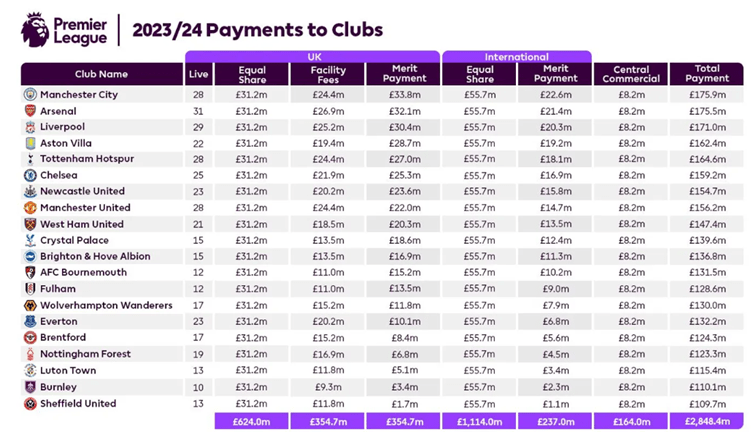
Every Premier League club received £86.9m in guaranteed equal share payments in 2023/24 (£55m from International)
Man United will lose more than £20m in merit payments in the 2024/25 season as the attempt to transition under Amorim, and whilst their facilities fee (based on number of live TV matches) will be higher than the likes of Brentford and Bournemouth they will in all likelihood earn less in total from the Premier League TV deal.
Sir Jim Ratcliffe is looking for pennies down the back of the sofa when there are potentially £millions staring him in the face.
An alliance of the Premier League power houses could smash the current distribution model in the next round of broadcast negotiations. Meritocracy is all well and good until clubs stop performing – why take the risk of relying on League positions when they could just hoover up a bigger share of the current equal share (especially the International revenue) which they could argue they deserve.
Conclusion: A League at a Crossroads
The Premier League is still an incredible product. But is the magic fading. This season — flat, predictable, often lifeless — could be a warning shot.
Fans are switching off. Clubs are re-prioritising. Revenues are being questioned. And the power clubs are restless.
If the league doesn’t adapt — doesn’t find a way to restore jeopardy, tighten competition, and give meaning to every matchday — then it risks becoming a stepping stone to bigger stages. Or worse, an outdated model.
Because when the biggest clubs no longer see the Premier League as the ultimate prize… why should anyone else?
 Bet Builder Buzz